

Every day, billions of posts vanish into the void — unseen, unshared, forgotten. But occasionally, something breaks through. It spreads. It gets screenshotted, reposted, quoted, and discussed. What separates that content from everything else isn’t talent. It isn’t timing alone. It’s a formula — and once you understand it, you can replicate it deliberately.
Why Most Content Dies in the Dark
Here’s the uncomfortable truth: most creators are making content for themselves, not for their audience. They pick topics they find interesting, use formats they’re comfortable with, and post at times that are convenient for them. Then they wonder why nobody shares it.
Viral content isn’t about broadcasting — it’s about giving people something they want to pass on. The moment you shift your thinking from “what do I want to say?” to “why would someone share this?”, everything changes.
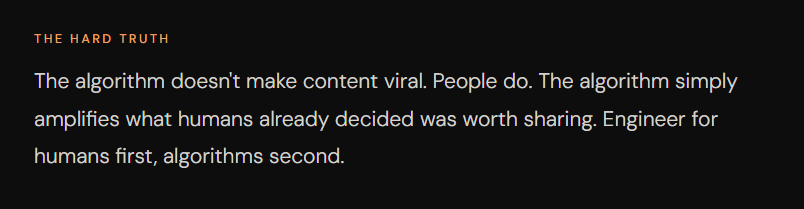
Platforms like Instagram, TikTok, YouTube Shorts, and X are all governed by the same invisible law: engagement signals determine reach. The algorithm doesn’t decide what’s good — it amplifies what people respond to. Your job is to trigger that response in the first three seconds.
The Six Emotions That Drive Every Share
Jonah Berger’s landmark research in his book Contagious revealed something counterintuitive: people don’t share information — they share feelings. Every piece of content that goes viral is riding on at least one of six core emotional triggers:
- ✓Awe — “I had no idea this was possible.” Scale, beauty, and the extraordinary.
- ✓Humor — Laughter is the most contagious human experience. Even a weak joke shared at the right moment spreads.
- ✓Anger — Outrage is a powerful sharer. Injustice, hypocrisy, and contradiction all trigger it.
- ✓Anxiety — “You need to know this.” Warning-based content thrives on urgency.
- ✓Inspiration — Transformation stories, underdog wins, and comeback arcs hit deep.
- ✓Identity — “This is so me.” Content that validates who someone is gets shared as self-expression.
Before you publish anything, ask yourself: which of these emotions does this content produce? If your honest answer is “none,” go back and rewrite it. A technically perfect, beautifully designed post that produces no emotional response will never, ever spread.

Hook First, Everything Else Second
You have three seconds. Sometimes less. On short-form video platforms, the first frame is your entire pitch. On social feeds, the first line of text is your headline, your promise, and your invitation — all in one. If you lose people here, nothing else matters.
The anatomy of a great hook follows a simple pattern: Interrupt → Intrigue → Promise. You interrupt the scroll, create a knowledge gap the viewer desperately wants filled, and hint at a payoff worth staying for.
Compare these two openers for the same piece of content:
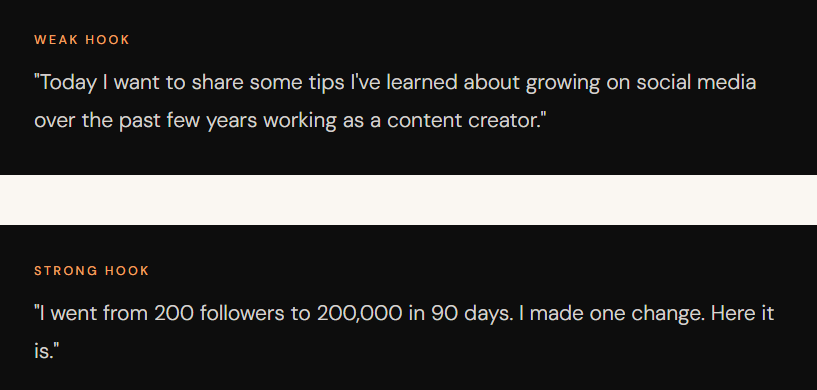
The second hook creates a knowledge gap. It makes a bold, specific claim. It implies a secret. Your brain physically cannot not want to know what that change was. That’s the hook doing its job.
The Anatomy of a Viral Post
Viral content, regardless of format or platform, almost always shares the same structural DNA. Here it is broken down as a repeatable blueprint:
- The Pattern Interrupt: Open with something that breaks expectation — a surprising stat, a bold claim, a visual anomaly, or a counterintuitive statement. Make stopping feel involuntary.
- The Relatable Setup: Establish common ground with your audience. Make them nod and think, “Yes, that’s exactly how it feels.” You need them emotionally onboard before you deliver the value.
- The Tension Arc: Every good story has a problem. Introduce conflict — a struggle, a challenge, a mistake made. Tension is what keeps people reading or watching. No tension, no retention.
- The Payoff: Deliver the insight, reveal, punchline, or solution. This is where the emotional release happens — and emotional release is exactly what people want to share with others.
- The Shareable Moment: End with something quotable, re-watchable, or screenshot-worthy. Give your audience the perfect “exit line” to pass along.
Riding the Wave: Trends vs. Timeless
There’s a constant debate among creators: should you chase trends or build evergreen content? The answer is — strategically, both. But you need to understand the difference between them and what each delivers.
Trend-based content is rocket fuel. When you attach your message to a trending audio, meme format, news story, or cultural moment, you borrow the momentum of something people are already searching for and talking about. Your content gets a visibility boost that would take months to build organically. The downside? Shelf life is hours, sometimes minutes.
Evergreen content is your compound interest. A genuinely helpful, well-structured post on a timeless topic — how to do something, why something works, what most people get wrong — keeps getting found, shared, and saved for months or years. It builds authority. It attracts followers who stay.
The winning formula: use trending formats to attract attention, and fill them with evergreen substance to convert that attention into loyal followers. Ride the wave of the trend — but deliver content that would still be worth reading six months from now.
The Psychology of Shareability
People share content for deeply personal, self-serving reasons — and there’s nothing cynical about that. Understanding this is one of the most powerful unlocks in content creation. When you share something, you’re doing one of a handful of things:
You’re signaling your values — “I believe in this.” You’re entertaining your audience — “My followers will love this.” You’re helping someone you care about — “My friend needs to see this.” You’re expressing your identity — “This is so me.” Or you’re establishing your expertise — “I knew about this before it went mainstream.”
When you design content, ask yourself: which of these motivations does this content serve? If the answer is clear, you’ve built a content piece with a natural sharing incentive baked in. If you can’t identify a sharing motivation, your audience won’t be able to either.
Consistency Is the Actual Algorithm Hack
Creators obsess over hacks — the best posting time, the magic hashtag count, the perfect caption length. And while these details matter at the margins, the single biggest driver of growth that most creators underestimate is consistency.
Algorithms reward accounts that post regularly. More importantly, audiences are built through repetition. It takes multiple exposures before someone goes from “I’ve seen this person before” to “I follow this person.” Every time you show up consistently, you build a little more of that recognition — and recognition is the foundation of trust, and trust is the foundation of a loyal audience.
Set a sustainable publishing cadence — one you can hold for six months without burning out — and commit to it completely. A creator who posts three times a week for six months will almost always outperform a creator who posts seven times a week for six weeks and then disappears.
Your Action Plan Starts Today
Viral content is not a lightning strike. It’s a system. And like any system, it gets more reliable the more intentionally you run it. Start by auditing your last ten pieces of content against the framework above: Did they trigger an emotion? Did they open with a genuine hook? Did they give people a reason to share?
Then pick one piece — just one — and rebuild it using the five-part structure outlined here. You’ll feel the difference immediately. It will read differently, feel differently, and perform differently.
The creators who consistently go viral aren’t lucky. They’re relentless students of human psychology, obsessive about their hooks, and disciplined enough to show up even when the numbers are disappointing. That’s the real formula — and now you have it.
The question is no longer whether you know how to make viral content. The question is whether you’ll actually do it.