

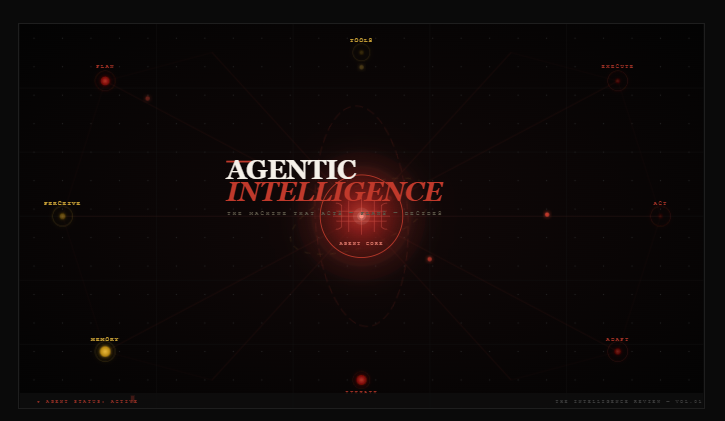
WHAT IS AGENTIC AI?
Agentic AI doesn’t wait to be asked twice. It plans, decides, executes — and the world may never be the same.
You’ve been using AI wrong this whole time. Not your fault — that’s simply what the technology allowed. You typed a prompt, the machine typed back, and somewhere in that endless back-and-forth, you convinced yourself that this was intelligence. It wasn’t. It was autocomplete with ambitions. But something has shifted. Quietly, irreversibly, the game has changed — and the name of the change is Agentic AI.
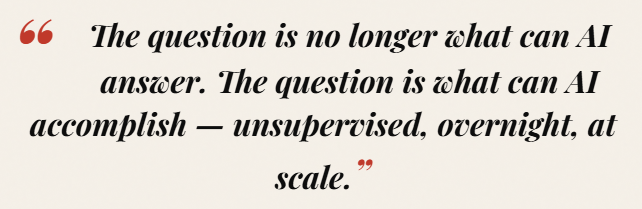
Forget the chatbot that answers your questions. Forget the assistant that drafts your emails when you hold its hand. Agentic AI is something categorically different: an artificial intelligence that sets its own sub-goals, chooses its own tools, takes independent action in the real world, and iterates — all to complete a task you described just once. You tell it what you want. It figures out how.
Agentic AI refers to AI systems capable of autonomous, multi-step reasoning and action — perceiving their environment, forming plans, using tools, and adapting based on feedback — without requiring human input at each step.
From Responder to Initiator
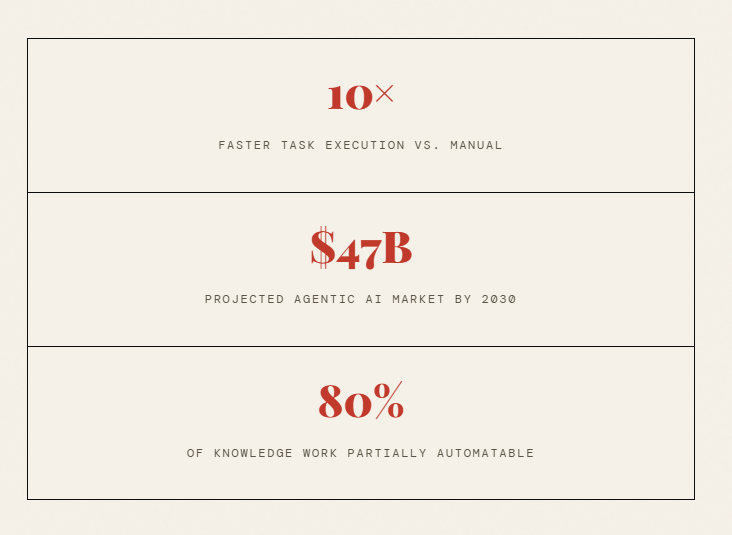
To understand why this is a leap — not a step — you need to feel the difference. Traditional AI is reactive. It lives in question-and-answer time. You ask, it answers. Every action requires a human trigger. Remove the human, and nothing happens.
Agentic AI is proactive. Hand it a goal — “Research the competitive landscape for our new product, draft a report, and email it to the team by Friday” — and it moves. It searches the web, reads documents, synthesizes findings, writes the report, and sends the email. No further instructions required. The human is liberated from the process, not chained to it.
The technical ingredients that make this possible are deceptively elegant: a large language model forms the “brain”; tool-use APIs give it arms to reach into the real world (browsers, code environments, databases, APIs); a memory system lets it carry context across steps; and a feedback loop allows it to check its own work, catch errors, and self-correct. Stack these components and you no longer have an AI that talks about doing things — you have one that does them.
What separates an agentic system from its predecessors is a cluster of capabilities that, individually, are impressive — but together, constitute something genuinely new:
- Planning: Breaking a complex goal into ordered sub-tasks and sequencing them logically.
- Tool Use: Calling external functions — web search, code execution, form-filling — to gather and act on real-world data.
- Memory: Retaining and referencing earlier steps so the overall task stays coherent across dozens of actions.
- Self-Correction: Evaluating its own outputs, detecting mistakes, and revising its approach mid-task.
- Parallelization: Spawning multiple sub-agents to handle different workstreams simultaneously — the AI equivalent of building a team.
Each capability alone is notable. Combined, they produce a system that can operate at a depth and duration that no previous AI model could sustain — and no single human could match for pure, tireless execution.
Where Agents Are Already Working
This isn’t science fiction mapped to a distant horizon. Agentic AI is already embedded in industries that touch your daily life, quietly transforming what a workday looks like for millions of professionals.
In software development, AI agents are writing code, running tests, catching bugs, and deploying fixes — full development cycles that previously required teams of engineers. In healthcare, agentic systems are reviewing patient records, cross-referencing drug interactions, and generating diagnostic summaries for physicians to review. In finance, agents monitor portfolios around the clock, flagging anomalies and generating reports before markets open. In customer operations, they handle entire support resolution flows — from understanding the complaint to issuing refunds — without a human ever reading the ticket.
The pattern is consistent: wherever there is a defined outcome, a digital environment to operate in, and structured data to reason about, an agent can operate. The scope of that “wherever” is expanding every quarter.
The Tension That Defines This Moment
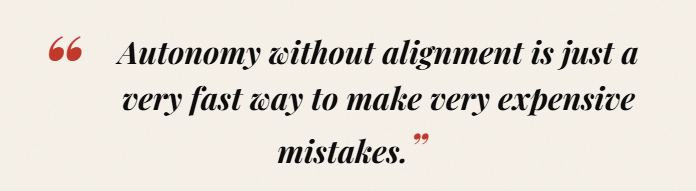
Here is where intellectual honesty demands we slow down. Agentic AI is powerful precisely because it is autonomous — and autonomy is not inherently safe. An agent operating over dozens of steps without human oversight can compound small errors into large ones. It can misinterpret intent and execute the letter of an instruction while completely violating its spirit. It can take actions — sending an email, deleting a file, placing an order — that are irreversible.
The AI safety community has a term for this: alignment at scale. It is relatively tractable to ensure a model answers a single question in an aligned way. It is substantially harder to ensure a model executing 50 sequential actions — each decision influencing the next — remains aligned with human intent from start to finish.
This is why the best agentic deployments today are designed with checkpoints: moments where the agent pauses, surfaces its plan, and waits for human confirmation before proceeding. The goal is not to remove humans from the loop entirely, but to radically change where in the loop humans are placed — from approving every action to approving every strategy.
What This Means for You
Whether you are a business leader, a developer, a student, or simply a person navigating a world increasingly shaped by AI — agentic systems will restructure the assumptions you’ve made about what requires human time. The economic implications are staggering and still largely unpriced. The ethical implications are urgent and largely underdiscussed.
The competitive advantage of the next decade will not be who has the most data or the fastest processors. It will be who understands how to design, deploy, and supervise agentic systems responsibly — harnessing their capability while preserving human judgment at the moments it matters most.