Digital Marketing Trends Rewriting the Rules in 2026
AI is no longer a tool — it’s your competition. Here’s everything your agency needs to know to stay ahead, get found, and win clients this year.
The digital marketing landscape has never changed faster than it is right now. In 2026, the rules have been fundamentally rewritten — not just tweaked. AI is answering questions before users click your website. Search engines are thinking. And your clients’ customers are discovering brands on platforms that didn’t even matter two years ago. This guide breaks down the 8 most powerful digital marketing trends of 2026 — and exactly what you should do about each one.
GEO: The New SEO Nobody Is Talking About Enough
If your agency is still only optimizing for Google’s blue links, you’re fighting last year’s war. Welcome to the era of Generative Engine Optimization (GEO) — the discipline of making your content visible to AI systems like ChatGPT, Perplexity, Google’s AI Overviews, and Microsoft Copilot.
These AI platforms don’t rank pages — they cite sources. They pull information from content that is structured, authoritative, and semantically rich. Your goal is no longer just to rank #1 on Google. It’s to become the source that AI systems trust and reference when your clients’ customers ask questions.
The End of Content Volume — Quality Is the New Currency
2026 officially killed the “publish more” strategy. Brands that were pumping out five blogs a day are watching their engagement crater. Meanwhile, agencies producing one deeply researched, genuinely useful piece per week are winning — in search, in social, and in AI citations.
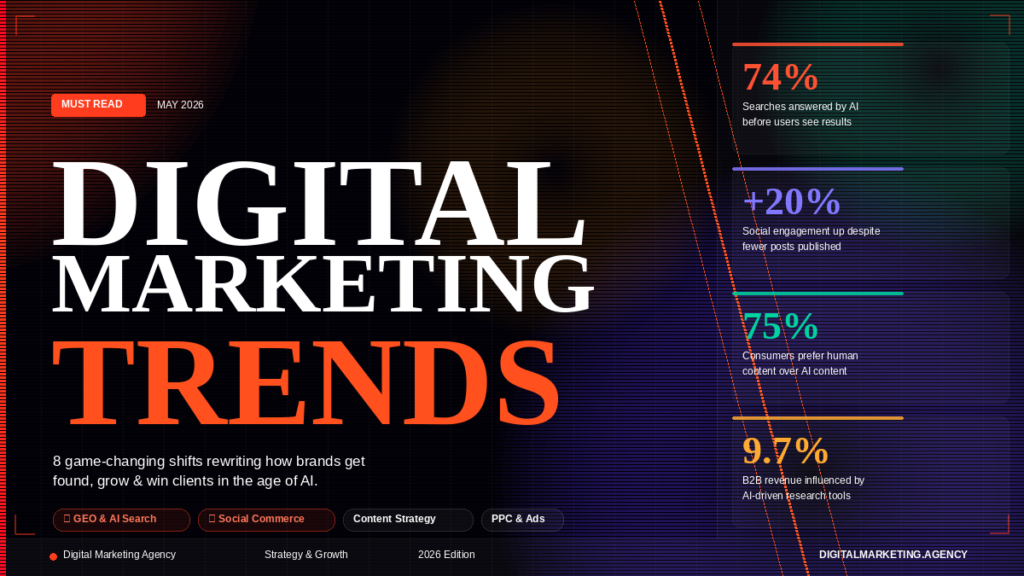
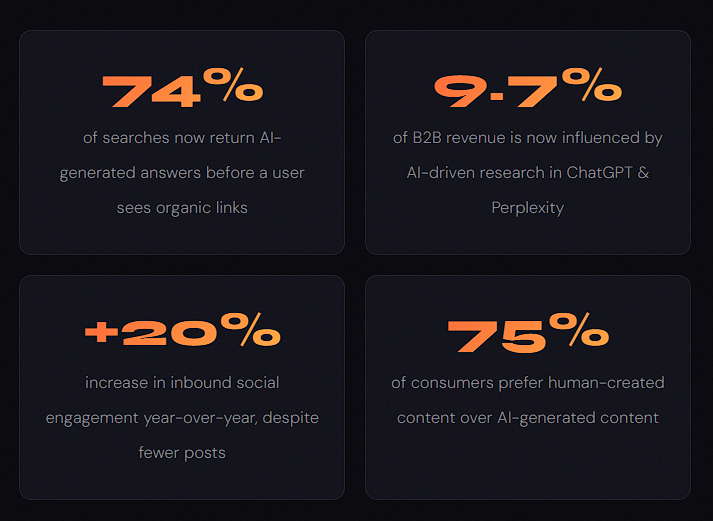
Average brand posting frequency dropped to 9.5 posts per day across social platforms, yet inbound engagement rose 20% year over year. The signal is unmistakable: audiences and algorithms alike are rewarding depth over breadth.
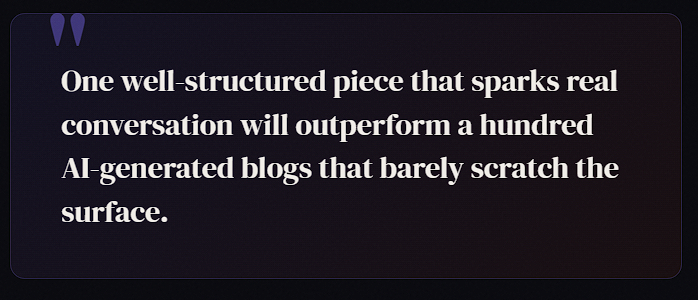
Your content calendar in 2026 should look like a magazine, not a news ticker. Invest in original research, proprietary data, expert interviews, and opinions that only your agency can give. That’s what gets cited. That’s what gets shared. That’s what gets you clients.
Human-First Content: Authenticity Is a Competitive Advantage
Here’s the irony of the AI content boom: the more AI-generated content floods the internet, the more valuable genuinely human content becomes. Ipsos research tracked this shift over three years — by 2025, between 64% and 75% of consumers actively preferred human-made content depending on the category.
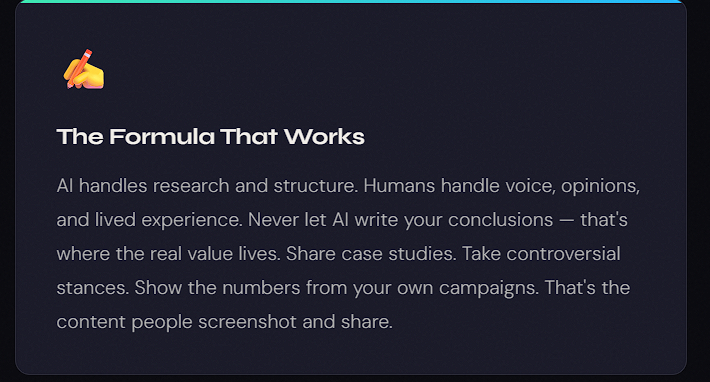
This isn’t a rejection of AI. It’s a rejection of soulless AI content — the kind that says nothing, takes no stance, and could have been written by anyone. The brands winning right now are using AI as a drafting and research tool, but injecting real opinions, real experience, and real personality into every piece.
The Channel Collapse: Your Brand Needs to Be Everywhere, Seamlessly
In 2026, the journey of a customer discovering a brand looks something like this: they watch a TikTok video about your product, skim a snippet on Google Discover, ask a follow-up in ChatGPT, watch a YouTube review, then visit your website to buy. That entire journey spans five platforms — and none of them are traditional.
The old model of managing separate strategies for each channel is dead. Cross-channel coherence is now table stakes. Your Instagram, your blog, your YouTube, and your AI presence all need to tell the same story — with content adapted for how each platform surfaces information.
- Repurpose long-form blog content into TikTok scripts, LinkedIn carousels, and email newsletters
- Ensure brand voice is consistent across AI-generated summaries and your own website copy
- Use structured data so your content indexes correctly across search, social, and AI platforms
- Track multi-touch attribution — not just last-click convers.
Social Commerce Is Eating Retail — And It’s Only Getting Hungrier
The line between scrolling and shopping has completely dissolved. Instagram, TikTok Shop, and Pinterest have transformed from inspiration platforms into full commerce engines. Consumers are now discovering, researching, and buying entirely within a single app — without ever touching your website.
For agencies, this means your clients’ product pages, reviews, creator partnerships, and checkout experiences all need to live natively within social platforms. If your client is selling physical products and they don’t have a TikTok Shop strategy in 2026, they are leaving a significant — and growing — revenue stream on the table.
AI-Powered Advertising: The Algorithm Works for You (If You Feed It Well)
Google’s Performance Max, Meta Advantage+, and TikTok’s Smart Performance Campaigns are running full autonomous ad cycles in 2026. AI decides the audience, the bidding, the creative variation, and the placement. Your job as a marketer? Train the machine with quality inputs.
Agencies that think AI ad platforms are a “set it and forget it” solution are burning client budgets. The difference between campaigns that work and campaigns that don’t is almost entirely in the quality of the creative, the strength of the landing page, and the clarity of the conversion signal. Garbage in, garbage out — at 10x the speed.
Voice Search & Conversational Queries Are Reshaping Content Structure
When someone asks Google Home “What’s the best digital marketing agency for e-commerce brands in India?” — they’re not searching a keyword. They’re asking a question. And the content that gets surfaced is content written in natural, conversational language with clear, direct answers.
Voice search optimization in 2026 means writing the way people speak. Use FAQ sections. Answer questions in the first two sentences of each section. Use simple sentence structures. Target long-tail conversational phrases. This approach also happens to be exactly what makes content perform better in AI Overviews — two birds, one stone.
First-Party Data Is Your Most Valuable Asset — Start Collecting It Now
Third-party cookies are gone. Walled garden data is increasingly restricted. The brands and agencies that built robust first-party data ecosystems — email lists, loyalty programs, quizzes, surveys, community platforms — are now sitting on a goldmine that competitors simply cannot replicate.
In 2026, data privacy isn’t just a compliance issue. It’s a competitive strategy. Clients who own their audience data can personalize at scale, retarget without relying on ad networks, and build customer lifetime value that compounds year over year. If your agency isn’t helping clients build first-party data funnels, start that conversation today