
techarchiko.com

Author name: adarshsingh1403@gmail.com

DIGITAL MARKETING TRENDS 2026
Uncategorized

Digital Marketing Trends Rewriting the Rules in 2026

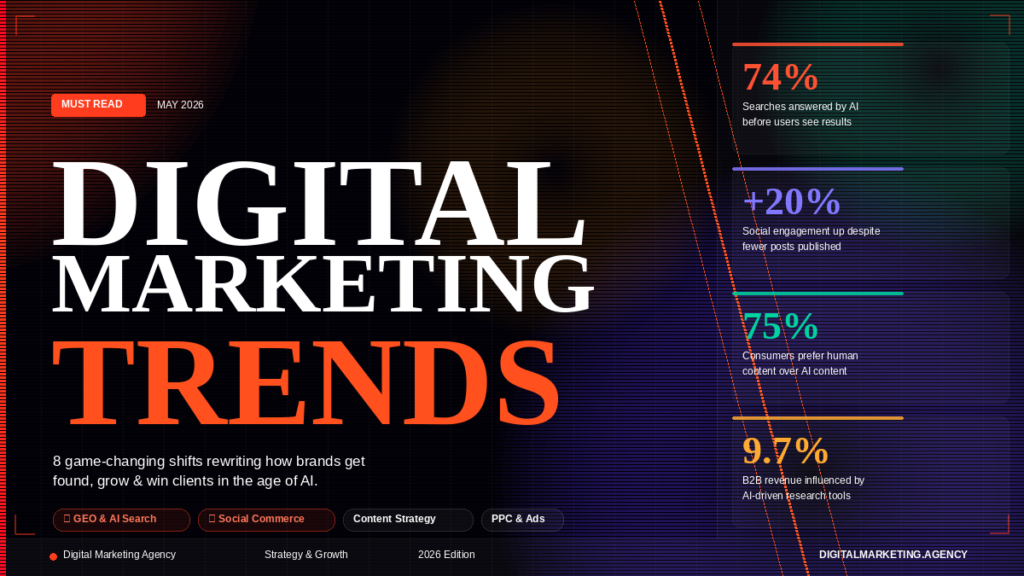
Digital Marketing Trends Rewriting the Rules in 2026 AI is no longer a tool — it’s your competition. Here’s everything your agency needs to know to stay ahead, get found, and win clients this year. The digital marketing landscape has never changed faster than it is right now. In 2026, the rules have been fundamentally rewritten — not just tweaked. AI is answering questions before users click your website. Search engines are thinking. And your clients’ customers are discovering brands on platforms that didn’t even matter two years ago. This guide breaks down the 8 most powerful digital marketing trends of 2026 — and exactly what you should do about each one. GEO: The New SEO Nobody Is Talking About Enough If your agency is still only optimizing for Google’s blue links, you’re fighting last year’s war. Welcome to the era of Generative Engine Optimization (GEO) — the discipline of making your content visible to AI systems like ChatGPT, Perplexity, Google’s AI Overviews, and Microsoft Copilot. These AI platforms don’t rank pages — they cite sources. They pull information from content that is structured, authoritative, and semantically rich. Your goal is no longer just to rank #1 on Google. It’s to become the source that AI systems trust and reference when your clients’ customers ask questions. The End of Content Volume — Quality Is the New Currency 2026 officially killed the “publish more” strategy. Brands that were pumping out five blogs a day are watching their engagement crater. Meanwhile, agencies producing one deeply researched, genuinely useful piece per week are winning — in search, in social, and in AI citations. Average brand posting frequency dropped to 9.5 posts per day across social platforms, yet inbound engagement rose 20% year over year. The signal is unmistakable: audiences and algorithms alike are rewarding depth over breadth. Your content calendar in 2026 should look like a magazine, not a news ticker. Invest in original research, proprietary data, expert interviews, and opinions that only your agency can give. That’s what gets cited. That’s what gets shared. That’s what gets you clients. Human-First Content: Authenticity Is a Competitive Advantage Here’s the irony of the AI content boom: the more AI-generated content floods the internet, the more valuable genuinely human content becomes. Ipsos research tracked this shift over three years — by 2025, between 64% and 75% of consumers actively preferred human-made content depending on the category. This isn’t a rejection of AI. It’s a rejection of soulless AI content — the kind that says nothing, takes no stance, and could have been written by anyone. The brands winning right now are using AI as a drafting and research tool, but injecting real opinions, real experience, and real personality into every piece. The Channel Collapse: Your Brand Needs to Be Everywhere, Seamlessly In 2026, the journey of a customer discovering a brand looks something like this: they watch a TikTok video about your product, skim a snippet on Google Discover, ask a follow-up in ChatGPT, watch a YouTube review, then visit your website to buy. That entire journey spans five platforms — and none of them are traditional. The old model of managing separate strategies for each channel is dead. Cross-channel coherence is now table stakes. Your Instagram, your blog, your YouTube, and your AI presence all need to tell the same story — with content adapted for how each platform surfaces information. Repurpose long-form blog content into TikTok scripts, LinkedIn carousels, and email newsletters Ensure brand voice is consistent across AI-generated summaries and your own website copy Use structured data so your content indexes correctly across search, social, and AI platforms Track multi-touch attribution — not just last-click convers. Social Commerce Is Eating Retail — And It’s Only Getting Hungrier The line between scrolling and shopping has completely dissolved. Instagram, TikTok Shop, and Pinterest have transformed from inspiration platforms into full commerce engines. Consumers are now discovering, researching, and buying entirely within a single app — without ever touching your website. For agencies, this means your clients’ product pages, reviews, creator partnerships, and checkout experiences all need to live natively within social platforms. If your client is selling physical products and they don’t have a TikTok Shop strategy in 2026, they are leaving a significant — and growing — revenue stream on the table. AI-Powered Advertising: The Algorithm Works for You (If You Feed It Well) Google’s Performance Max, Meta Advantage+, and TikTok’s Smart Performance Campaigns are running full autonomous ad cycles in 2026. AI decides the audience, the bidding, the creative variation, and the placement. Your job as a marketer? Train the machine with quality inputs. Agencies that think AI ad platforms are a “set it and forget it” solution are burning client budgets. The difference between campaigns that work and campaigns that don’t is almost entirely in the quality of the creative, the strength of the landing page, and the clarity of the conversion signal. Garbage in, garbage out — at 10x the speed. Voice Search & Conversational Queries Are Reshaping Content Structure When someone asks Google Home “What’s the best digital marketing agency for e-commerce brands in India?” — they’re not searching a keyword. They’re asking a question. And the content that gets surfaced is content written in natural, conversational language with clear, direct answers. Voice search optimization in 2026 means writing the way people speak. Use FAQ sections. Answer questions in the first two sentences of each section. Use simple sentence structures. Target long-tail conversational phrases. This approach also happens to be exactly what makes content perform better in AI Overviews — two birds, one stone. First-Party Data Is Your Most Valuable Asset — Start Collecting It Now Third-party cookies are gone. Walled garden data is increasingly restricted. The brands and agencies that built robust first-party data ecosystems — email lists, loyalty programs, quizzes, surveys, community platforms — are now sitting on a goldmine that competitors simply cannot replicate. In 2026, data privacy isn’t just a compliance issue. It’s a competitive strategy. Clients who own their audience data can personalize at scale, retarget without relying on ad networks,


WHAT IS PERSONAL FINANCE
Uncategorized

WHAT IS PERSONAL FINANCE AND WHY ITS IMPORTANT?

WHAT IS PERSONAL FINANCE? Personal Finance —The Art of OwningYour Future Most people go through their entire lives earning money, spending it, and hoping things work out. Personal finance is the deliberate alternative — the practice of making your money work for you, not against you. What Is Personal Finance? Personal finance is the process of managing your money to meet your life goals. It covers everything from how much you earn to how you spend, save, invest, protect, and plan for the future. Think of it as your relationship with money — and like any relationship, the quality of it shapes your quality of life. At its core, personal finance answers a set of fundamental questions: How do I make more money? How do I keep more of what I make? Where should I put my savings? How do I protect my family if something goes wrong? And perhaps most importantly — how do I build a life I don’t need to escape from? It is not just for the wealthy. In fact, personal finance matters more when resources are limited, because every rupee carries more weight and every decision has a more direct impact on daily life. The Five Pillars of Personal Finance Why Personal Finance Matters Financial stress is one of the leading causes of anxiety, broken relationships, and poor health globally. When you live paycheck to paycheck without a plan, every unexpected expense — a medical bill, a car repair, a job loss — becomes a crisis. Personal finance is the buffer between you and chaos. Good personal finance habits create what economists call optionality — the freedom to make choices based on what you want, not what you can afford. Want to start a business? Take a sabbatical? Move to a new city? None of that is possible when money is a constant constraint. Beyond individual freedom, financial literacy has a generational impact. Families that understand money tend to pass those habits down. Children who grow up in financially literate households are more likely to avoid debt traps, invest early, and build wealth across generations. Where Most People Go Wrong The biggest financial mistake is not starting. People delay budgeting because it feels restrictive, avoid investing because it feels risky, and ignore insurance because it feels unnecessary — until the day it isn’t. Procrastination is the single most expensive financial habit. The second mistake is lifestyle inflation. As income grows, so do expenses — new phone, bigger apartment, premium subscriptions. Without intentional saving, higher earnings simply fund a more expensive version of the same financial insecurity. And the third? Treating personal finance as complicated. It isn’t. The basics — spend less than you earn, save consistently, invest early, stay insured — are simple. The challenge is not understanding them. It is doing them. Starting Your Financial Journey You do not need a finance degree or a large salary to begin. Start with one clear step: track every expense for 30 days. Just awareness. Then build from there — a small emergency fund, a monthly SIP, a term insurance policy. Each step compounds, financially and psychologically. The best time to take control of your finances was ten years ago. The second best time is today. Why Personal Finance Matters Financial stress is one of the leading causes of anxiety, broken relationships, and poor health globally. When you live paycheck to paycheck without a plan, every unexpected expense — a medical bill, a car repair, a job loss — becomes a crisis. Personal finance is the buffer between you and chaos.

WHAT IS AGENTIC AI
Uncategorized

What is agentic ai?

WHAT IS AGENTIC AI? The Machine ThatActually Acts Agentic AI doesn’t wait to be asked twice. It plans, decides, executes — and the world may never be the same. You’ve been using AI wrong this whole time. Not your fault — that’s simply what the technology allowed. You typed a prompt, the machine typed back, and somewhere in that endless back-and-forth, you convinced yourself that this was intelligence. It wasn’t. It was autocomplete with ambitions. But something has shifted. Quietly, irreversibly, the game has changed — and the name of the change is Agentic AI. Forget the chatbot that answers your questions. Forget the assistant that drafts your emails when you hold its hand. Agentic AI is something categorically different: an artificial intelligence that sets its own sub-goals, chooses its own tools, takes independent action in the real world, and iterates — all to complete a task you described just once. You tell it what you want. It figures out how. Agentic AI refers to AI systems capable of autonomous, multi-step reasoning and action — perceiving their environment, forming plans, using tools, and adapting based on feedback — without requiring human input at each step. From Responder to Initiator To understand why this is a leap — not a step — you need to feel the difference. Traditional AI is reactive. It lives in question-and-answer time. You ask, it answers. Every action requires a human trigger. Remove the human, and nothing happens. Agentic AI is proactive. Hand it a goal — “Research the competitive landscape for our new product, draft a report, and email it to the team by Friday” — and it moves. It searches the web, reads documents, synthesizes findings, writes the report, and sends the email. No further instructions required. The human is liberated from the process, not chained to it. The technical ingredients that make this possible are deceptively elegant: a large language model forms the “brain”; tool-use APIs give it arms to reach into the real world (browsers, code environments, databases, APIs); a memory system lets it carry context across steps; and a feedback loop allows it to check its own work, catch errors, and self-correct. Stack these components and you no longer have an AI that talks about doing things — you have one that does them. The Five Powers of an Agent What separates an agentic system from its predecessors is a cluster of capabilities that, individually, are impressive — but together, constitute something genuinely new: Planning: Breaking a complex goal into ordered sub-tasks and sequencing them logically. Tool Use: Calling external functions — web search, code execution, form-filling — to gather and act on real-world data. Memory: Retaining and referencing earlier steps so the overall task stays coherent across dozens of actions. Self-Correction: Evaluating its own outputs, detecting mistakes, and revising its approach mid-task. Parallelization: Spawning multiple sub-agents to handle different workstreams simultaneously — the AI equivalent of building a team. Each capability alone is notable. Combined, they produce a system that can operate at a depth and duration that no previous AI model could sustain — and no single human could match for pure, tireless execution. Where Agents Are Already Working This isn’t science fiction mapped to a distant horizon. Agentic AI is already embedded in industries that touch your daily life, quietly transforming what a workday looks like for millions of professionals. In software development, AI agents are writing code, running tests, catching bugs, and deploying fixes — full development cycles that previously required teams of engineers. In healthcare, agentic systems are reviewing patient records, cross-referencing drug interactions, and generating diagnostic summaries for physicians to review. In finance, agents monitor portfolios around the clock, flagging anomalies and generating reports before markets open. In customer operations, they handle entire support resolution flows — from understanding the complaint to issuing refunds — without a human ever reading the ticket. The pattern is consistent: wherever there is a defined outcome, a digital environment to operate in, and structured data to reason about, an agent can operate. The scope of that “wherever” is expanding every quarter. The Tension That Defines This Moment Here is where intellectual honesty demands we slow down. Agentic AI is powerful precisely because it is autonomous — and autonomy is not inherently safe. An agent operating over dozens of steps without human oversight can compound small errors into large ones. It can misinterpret intent and execute the letter of an instruction while completely violating its spirit. It can take actions — sending an email, deleting a file, placing an order — that are irreversible. The AI safety community has a term for this: alignment at scale. It is relatively tractable to ensure a model answers a single question in an aligned way. It is substantially harder to ensure a model executing 50 sequential actions — each decision influencing the next — remains aligned with human intent from start to finish. This is why the best agentic deployments today are designed with checkpoints: moments where the agent pauses, surfaces its plan, and waits for human confirmation before proceeding. The goal is not to remove humans from the loop entirely, but to radically change where in the loop humans are placed — from approving every action to approving every strategy. What This Means for You Whether you are a business leader, a developer, a student, or simply a person navigating a world increasingly shaped by AI — agentic systems will restructure the assumptions you’ve made about what requires human time. The economic implications are staggering and still largely unpriced. The ethical implications are urgent and largely underdiscussed. The competitive advantage of the next decade will not be who has the most data or the fastest processors. It will be who understands how to design, deploy, and supervise agentic systems responsibly — harnessing their capability while preserving human judgment at the moments it matters most.

BASICS OF DIGITAL MARKETING
Uncategorized

Basics of Digital Marketing: Everything You Need to Know to Get Started

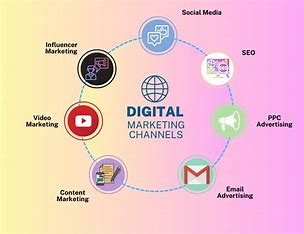
Basics of Digital Marketing: Everything You Need to Know to Get Started We live in an era where a teenager with a phone can reach more people in a day than a billboard could in a month. That’s the power of digital marketing — and it’s reshaping how businesses of every size grow, compete, and survive. But with so many channels, tools, and buzzwords flying around, getting started can feel overwhelming. This guide cuts through the noise. Whether you’re a student, a small business owner, or a professional looking to upskill, here’s what you genuinely need to understand about digital marketing — from first principles to practical channels. What is digital marketing? Digital marketing is the promotion of products, services, or brands using digital channels — the internet, search engines, social media, email, websites, and mobile apps. Unlike traditional marketing (TV, print, radio), digital marketing is measurable, interactive, and highly targetable. The goal is simple: connect with the right audience, at the right time, in the right place — and drive them to take a meaningful action, whether that’s buying a product, signing up for a newsletter, or simply building awareness of your brand. The core pillars of digital marketing The core pillars of digital marketing Think of digital marketing as a building. Each pillar supports the structure. Remove one and the building still stands — but it’s weaker. Here are the six essential pillars: Analytics: the backbone of it all None of the above works without measurement. Digital marketing’s greatest advantage over traditional marketing is that almost everything is trackable. Tools like Google Analytics 4 (GA4), Google Search Console, Meta Business Suite, and platforms like HubSpot show you exactly where your traffic comes from, what actions users take, where they drop off, and which campaigns deliver real ROI. The discipline of data-driven decision-making — forming a hypothesis, running a test, reading the results, and iterating — is what separates good digital marketers from great ones. Test everything: headlines, landing page copy, email subject lines, ad creatives, CTA buttons. Every failure teaches you something. Every success scales. Bringing it all together The most effective digital marketing strategies don’t treat these pillars in isolation. A well-optimised blog post (SEO + Content) gets shared on social media, drives email sign-ups, which are then nurtured through automated sequences — and underperforming content gets boosted with paid ads while analytics identify which topics resonate most. That’s a flywheel. Digital marketing is not a switch you flip. It’s a system you build, test, and refine over time. The brands that win aren’t necessarily those with the biggest budgets — they’re the ones who understand their audience deeply, create genuine value, and measure what matters. Start with one channel, master it, then expand. Consistency beats perfection every time. CLICK HERE TO DOWNLOAD PDF Search engine optimisation (SEO) SEO is the art and science of getting your website to appear at the top of search engine results pages (SERPs) without paying for ads. When someone searches “best running shoes under ₹3000,” SEO is what determines whether your page shows up on page one or page ten. Content marketing Content marketing is about creating and distributing valuable, relevant content to attract and retain a clearly defined audience. Think blog posts, YouTube videos, podcasts, infographics, eBooks, and case studies. The guiding principle is: instead of interrupting people with ads, earn their attention by being genuinely useful. Social media marketing Social media marketing uses platforms like Instagram, LinkedIn, X (formerly Twitter), YouTube, and Facebook to build brand awareness, engage communities, and drive traffic. The key is understanding where your audience spends time — a B2B software company thrives on LinkedIn; a fashion brand lives on Instagram and Pinterest. Email marketing Often underestimated, email marketing consistently delivers the highest return on investment of any digital channel — historically around ₹3,600 returned for every ₹100 spent. Why? Because your email list is an audience you own. Unlike social media followers (who can disappear if a platform changes its algorithm), email subscribers are yours. Effective email marketing means segmenting your list, personalising content, and automating sequences — welcome emails, abandoned cart reminders, re-engagement campaigns — so the right message reaches the right person at the right moment. Pay-per-click (PPC) and paid advertising PPC is a model where you pay for each click on your ad. Google Ads is the most dominant platform — your ad appears at the top of search results for specific keywords, and you’re charged only when someone clicks. This is powerful for targeting high-intent buyers who are actively searching for what you offer.  

Uncategorized

AI’s Ouroboros Effect: How Growth Leaders Reinvent Next-Gen Teams

 AI eating its own self AI eating its own self AI eating its own self AI eating its own self AI eating its own self AI eating its own self AI eating its own self AI eating its own self AI eating its own self AI eating its own self AI eating its own self AI eating its own self AI eating its own self AI eating its own self AI eating its own self AI eating its own self AI eating its own self AI eating its own self AI eating its own self AI eating its own self AI eating its own self AI eating its own self AI eating its own self AI eating its own self AI eating its own self AI eating its own self AI eating its own self AI eating its own self AI eating its own self AI eating its own self AI eating its own self AI eating its own self AI eating its own self AI eating its own self AI eating its own self AI eating its own self AI eating its own self AI eating its own self AI eating its own self AI eating its own self AI eating its own self AI eating its own self  AI Eating Its Own Self: How can you use AI to grow your team and become #1 in the market.[Ouroboros Effect] AI eating its own self: How Marketing Leaders Rebuild Future-Ready Teams Short-term AI efficiency gains come with long-term talent pipeline costs. See why successful marketing leaders must invest in lasting team growth and how to start doing it today Ask most marketers today whether they’re worried about AI taking their jobs, and the answer might surprise you.  According to CMI’s 2026 Career and Salary Outlook: Content and Marketing Professionals, only 4% of full-time marketers believe AI will replace their role in the next five years. More than half (54%) expect it to make their work faster and more strategic. On layoffs specifically, 55% say they aren’t concerned. And for the most part, that confidence is warranted. Experienced marketers’ creative instincts, strategic judgment, and institutional knowledge are genuinely hard to replicate.  But while that threat dominates conversations, something else is developing. The tools meant to make teams more capable are now justifying less investment in them — fewer entry-level hires, more work spread across fewer people, and less development of the skills that matter in the long term. In Greek mythology, an ouroboros is a serpent that eats its own tail, forming a continuous circle. It’s an apt metaphor for what’s happening. Many marketing organizations are stuck in a slow, self-defeating cycle that’s easy to miss until the damage is done.  Related:How To Protect Your Most Important (and Undervalued) Marketing Asset Yet, the ouroboros also represents rebirth. That’s the better metaphor to inspire organizations to emerge stronger. But rebirth doesn’t happen on its own.  To understand how organizations actually break the cycle in favor of long-term growth, we spoke with CMOs, content leaders, and staffing experts. Three key issues emerged, centered on what happens when organizations stop investing in the conditions that make marketing work. The disappearing junior marketer  CMI’s research finds that 34% of marketers report a decrease in entry-level and new graduate hiring in their organization over the last two years, with only 14% reporting an increase. Mitangi Parekh, director of content marketing at cybersecurity company eSentire, sees it happening. More organizations ask themselves, she says, “Why are we hiring even a contractor to do some of this admin-level work if you have something like Claude or ChatGPT that can do this?” Charles Knuth, product marketing lead at Pave, says, “The junior marketer is becoming an endangered species in tech.” The compensation data company tracks the numbers closely. Charles shares its proprietary data: “Entry-level representation dropped from 8% to 4% in just two years, and AI tools absorbing executional work is a big reason why.” In that same timeframe, 28% of marketers CMI surveyed report that their organization has hired overqualified candidates, filling mid-level roles with people who have higher-level experience, further closing entry points for talent. Related:The Missing Generation: How AI Is Reshaping Content and Marketing Roles in 2026 The consequences have a long-term impact because junior roles are where marketers learn to think. “You need to have that marketing background and experience to be able to know whether something is good or not,” says Virginia Ford-Young, chief marketing officer at S&P Global Ratings. Marketers must develop that discernment somewhere, yet most organizations don’t have a plan for where. The burnout tax  CMI’s research finds 59% of marketers (and 66% of leaders) say their workload is at least somewhat overwhelming. Seventy-six percent feel like they’re doing the work of more than one person. And 91% believe their organizations expect too much. AI efficiency gains aren’t relieving the pressure. They’re raising the bar.  Gina Balarin, marketing consultant, author, and board member of the Chartered Institute of Marketing, sees where this trend has led. “We’ve reached a crisis point,” she says, “where humans are using AI tools to make themselves more productive to a point of exhaustion.” The consequences show up in the CMI data. Thirty-nine percent of marketers are actively pursuing or highly interested in finding a new job in 2026. Almost one in four freelances on the side. Related:How Long Will Content and Marketing Careers Remain Viable? [Research] These could be warning signs that valuable team members are building an exit strategy. CMI and Ravn Research developed an assessment tool to help you calculate employee flight risk and get specific intervention recommendations.   Pave’s data shows marketing has a 24% turnover rate, the highest overall rate of any function in tech. (Engineering turnover is at 17%.) “It’s not just a talent or compensation problem. It’s a signal about how quickly marketing regimes fall in and out of favor,” Charles says. Organizations underestimate how much that matters until people depart with their institutional knowledge and hard-won experience. The real necessary skills

Uncategorized

TOP 12 CONTENT CREATION AI TOOLS IN 2026

TOP 12 CONTENT CREATION AI TOOLS IN 2026 top 12 content creation ai tools in 2026 top 12 content creation ai tools in 2026 top 12 content creation ai tools in 2026 top 12 content creation ai tools in 2026 top 12 content creation ai tools in 2026 top 12 content creation ai tools in 2026 top 12 content creation ai tools in 2026 top 12 content creation ai tools in 2026  The benefits of AI content creation too Below are just some of the reasons why you should be considering making AI tools a staple of your content planning and creation, as we also provide you the top 12 content creation AI tools in 2026.   Time-saving Looking to get content online more quickly? According to one survey, a typical 500-word blog post takes around 4 hours complete. This doesn’t even take into account compiling a briefing, proofreading the first draft, and waiting on any revision requests to be completed. With a content creation tool, you can streamline the process considerably.  Increased efficiency and productivity Whether you outsource writing assignments or handle content creation in-house, an AI content generator can boost productivity. These powerful tools make quick work of blog ideation, while social media posts and compelling CTAs can be produced in seconds.  Cost savings Looking to slash costs? Outsourcing content to freelancers is relatively inexpensive. However, expect to pay upwards of $175 for a 1,500-word article. You can use AI writing assistant tools to control your outgoings. These tools can help refine the ideation and briefing process. Alternatively, you can leverage the potential of artificial intelligence to make content creation alleviate pressures on internal teams. Scalability If you want to create and distribute content at scale, you’ll need to invest a significant amount of time and money. Alternatively, use AI tools to automate processes for a more streamlined approach to content creation.  Improved SEO performance Long gone are the days when you had to rely on external support for SEO services. With the right AI tools at your disposal, you can carry out exhaustive keyword research and access optimization insights in seconds. Look for keyword trends, generate fresh and competitive content ideas, and play around with on-page elements to ensure your content is as optimized as it can be.   Enhanced content quality Although current AI content creation tools require the human touch to produce high-quality output, they’re getting much more efficient at their job. One of the main ways AI tools help with quality is by delivering consistent results. While tone of voice and context often needs a little finessing, the time saved on generating content from scratch can be put to better use during the editing stage. TOP 12 CONTENT CREATION AI TOOLS IN 2026 Looking to leverage the power of AI-generated content for yourself? Below, we explore 10 of the best AI tools you can put to good use today.  Jasper.ai: best for AI blog post writing Key Features If you’re looking to make quick work of blog posts, Jasper AI is worth checking out. Designed for personal users and businesses alike, this AI content writing tool comes with 50 templates to choose from. You can use it to create product descriptions for ecommerce platforms or generate the perfect posts for your social media channels. Adding briefing requirements is relatively straightforward, while you can play around with things like tone to ensure content is on brand.  Pricing For individual content creators, pricing starts from as little as $39 per month. Marketing teams can unlock additional features by signing up for an advanced package, with pricing set at $39 per month.  Pros  Huge range of content templates Integration with third-party tools like Grammarly Perfect for content ideation Cons Enterprise pricing can vary considerably Not the best solution if you’re looking to scale Unlocking the potential of third-party integrations will cost you Copy.ai: best for AI social media copywriting Key Features If you’re a content marketer looking for an effective AI writing tool, Copy.ai  is worth considering. While this tool can create all types of text, it’s best utilized for generating captivating social media content. An advanced drafting wizard gives you more control over the finished product, while handy knowledge-sharing tools make it a good pick for social media marketers looking to connect with other users.  Pricing Anyone can use this AI tool for free, although the free plan is limited to 10 credits per month. Upgrading to a small business account will set you back $49 per month, while custom pricing is available for larger teams.  Pros  User-friendly dashboard Streamlined content creation tool Good choice for those looking for a free-to-use AI tool Cons Not the best choice if you’re looking to produce long-form content You’ll need to upgrade to a custom account to unlock unlimited credits Surfer SEO: best for AI SEO writing Key Features If you’re looking for a tool to optimize content and improve search performance, Surfer SEO is the obvious choice. This multi-featured AI tool comes loaded with useful features, including a keyword analyses tool and a user-friendly content editor. You’ll get suggestions for headers, a comprehensive breakdown of competitive keywords, plus primers on how to finesse your content so it outperforms your main SEO challengers.  Pricing Surfer SEO is pretty competitive when it comes to pricing. A basic account costs $19 per month, while the most advanced version will set you back $249 per month. Pros  Excellent content editing interface Flexible customization options Third-party integration with Google Docs, WordPress, and more Cons Keyword suggestions aren’t always reliable The SERP Analyzer tool isn’t the easiest to use. Canva: best for AI image generation  Key Features With Canva, you don’t need any advanced coding knowledge to create high-quality graphics. What’s more, powerful image generation capabilities mean you produce premium visuals with just a few basic prompts. You can play around with aspect ratios, as well as apply after-effects so your generated imagery is ready for its destination.  Pricing You can start using Canva for free, although functionality is limited. Canva Pro is available for $12.99 per month, while team access can

Scroll to Top